Case Studies
Case Study: WarpCoder
WarpCoder turns a request into a numbered release, with planning, validation, proof on a clean machine, rollback-ready packaging, and a URL.
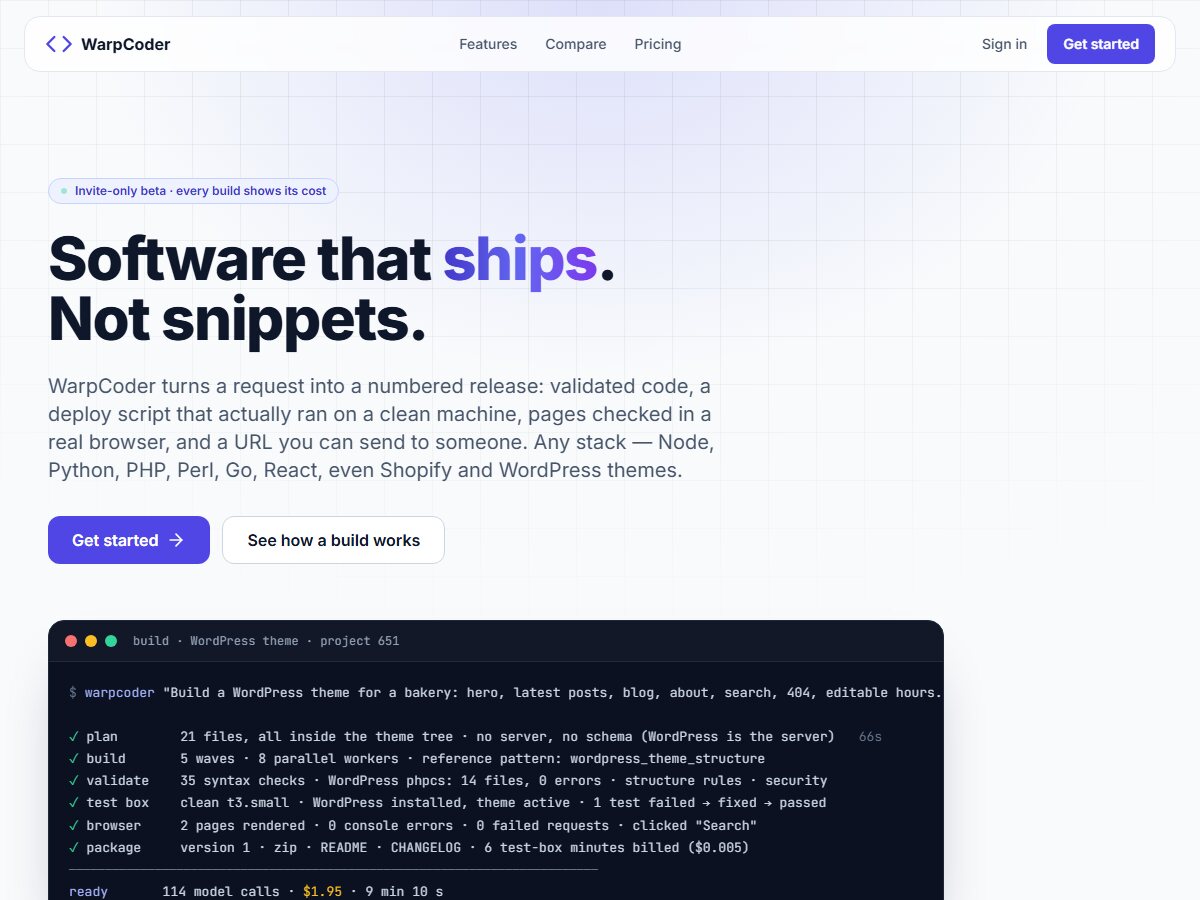
WarpCoder is an AI app and website builder we created at Omega Concepts to change what teams should expect from AI-assisted development. Instead of producing a diff and leaving the rest to the user, WarpCoder turns a request into a numbered release. That difference shapes the entire product. We designed it to plan the software first, wait for approval, build in parallel using proven patterns, validate the output at both the file level and the whole-project level, prove the release on a clean machine with a real browser, package it so it can be rolled back, and publish it with a URL. You can see the product at WarpCoder, which is currently available as an invite-only beta.
The problem it solves
Many AI coding tools are helpful at the prompt level, but they stop short of what teams actually need to ship software with confidence. A generated diff can be useful, yet it still leaves open questions about planning, consistency, validation, release packaging, rollback, and proof that the result works in a real environment. For teams building websites, applications, themes, or internal tools, that gap matters. The hard part is not only generating code. The hard part is turning a request into something structured, reviewed, checked, packaged, and ready to publish.
We built WarpCoder to solve that workflow problem directly. The goal was to move beyond isolated code generation and support a fuller release process. Rather than treating software delivery as a loose collection of AI outputs, WarpCoder organizes the work around a release. It plans first. It asks for approval. It builds through a defined process. It validates every file and then the whole project. It proves the release on a clean machine with a real browser. It then packages a numbered release that can be rolled back and publishes it with a URL. That sequence makes the product practical for real building, not just experimentation.
What we built
At its core, WarpCoder is an AI app and website builder for users who want to describe what they need and receive a release rather than a patch. We built it as both a product and a workflow engine around that outcome. A user starts with a request. WarpCoder plans the software and presents that plan for approval. Once approved, the system builds in parallel using proven patterns. From there, the result goes through validation at multiple levels before being proven on a clean machine with a real browser. Finally, WarpCoder packages the work as a numbered release, supports rollback, and publishes it with a URL.
We also built WarpCoder to be flexible across stacks. It supports Node, Python, PHP, Perl, Go, and React, as well as Shopify and WordPress themes. That breadth reflects an important product decision: we did not want the release-oriented workflow to be limited to one ecosystem. Whether the work involves an application, a website, or a theme, the same principle applies. Users should be able to go from request to a structured release process in a predictable way.
Another core part of the product is cost visibility. WarpCoder is built on token optimization and is 30 to 50% cheaper per build than comparable tools. Every build shows its cost. We consider that more than a pricing detail. It is part of the product experience, because teams need to understand what they are spending as they build. The result is a tool that aims to be both operationally practical and easier to evaluate during real use.
How it works and its key features
The WarpCoder flow begins with planning. Instead of immediately generating code, it plans the software and asks the user to approve the plan. This step creates a checkpoint before implementation starts. It gives the user a chance to confirm direction early, which is especially important when the goal is a full release rather than an isolated snippet.
After approval, WarpCoder builds in parallel using proven patterns. That approach is central to how we designed the system. The product is not framed as a one-shot generator. It is built to execute work through a structured process that emphasizes reliability and repeatability. Parallel building helps move the work forward efficiently while still following established patterns.
Validation is another major feature. WarpCoder validates every file and then validates the whole project. We made this two-level checking process part of the core workflow because software quality is rarely decided by one successful output alone. Individual files need to make sense, and the full project needs to hold together as a release candidate.
From there, WarpCoder proves the release on a clean machine with a real browser. This is one of the clearest expressions of the product philosophy. We wanted proof of the release in an environment that reflects actual execution rather than assumption. That proof step helps connect code generation to software delivery in a more complete way.
Once proven, WarpCoder packages the result as a numbered release. That release can be rolled back, which gives users a practical safeguard and a clearer sense of versioned progress. It also publishes the release with a URL, turning the final output into something accessible and shareable. In short, the key features include:
- Request-to-release workflow instead of diff-based output
- Planning with approval before implementation begins
- Parallel building using proven patterns
- Validation of every file followed by full-project validation
- Proof on a clean machine with a real browser
- Numbered releases that can be rolled back
- Publishing with a URL as part of the workflow
- Support for multiple stacks including Node, Python, PHP, Perl, Go, React, Shopify, and WordPress themes
- Visible build cost on every build
- Token optimization that makes it 30 to 50% cheaper per build than comparable tools
For a closer look at the product itself, visit the WarpCoder website builder and AI app platform.
The design decisions behind it
The most important decision behind WarpCoder was to center the product on releases rather than diffs. That choice influenced everything else. If the destination is a numbered release, then planning matters, approval matters, validation matters, proof matters, packaging matters, and rollback matters. We wanted the product to reflect how software is actually delivered, not just how code is generated.
Another key decision was to make approval part of the flow. Having WarpCoder plan the software and wait for approval adds clarity before the build starts. It creates a more deliberate process and helps align the user with the output before resources are spent on implementation.
We also chose to rely on proven patterns and parallel building. This was a practical design decision shaped by the kind of output we wanted WarpCoder to produce. The objective was not merely to generate code quickly, but to do so in a way that supports a more dependable path to a release.
Validation and proof were likewise deliberate. We included validation for every file and for the whole project because a release-oriented tool needs both granular and holistic checks. Proving the release on a clean machine with a real browser extends that logic further. It gives users a stronger basis for trust in the result.
Finally, we made cost transparency visible in the product itself. Because WarpCoder is built on token optimization, it is 30 to 50% cheaper per build than comparable tools, and every build shows its cost. We wanted users to see that information directly rather than treat cost as something hidden behind the process.
Who it is for
WarpCoder is for people and teams who want more than AI-generated code fragments. It is suited to those who need a structured path from request to release and who value planning, review, validation, proof, and rollback. Because it supports Node, Python, PHP, Perl, Go, React, Shopify, and WordPress themes, it fits a wide range of software and web development use cases.
It is especially relevant for users who want clearer control over what gets built and how the result is delivered. The approval step supports users who want to confirm direction before implementation. The validation and proof flow supports users who care about confidence in the output. The numbered release model supports users who want versioned delivery and rollback. And the visible build cost supports users who want transparency while evaluating AI-assisted building as part of their workflow.
How to try it
WarpCoder is currently in invite-only beta. If you want to explore a release-based approach to AI app and website building, the best place to start is WarpCoder at warpcoder.dev. There you can review the product and learn more about how it turns a request into a numbered release rather than a diff.
If you want to see more of the products and systems we build, visit our portfolio or reach out through our contact page.