Case Studies
Case Study: SEO Audit Tool
Our SEO Audit Tool helps website owners verify reachability, surface issues across up to 150 pages, and get a polished PDF with priorities.
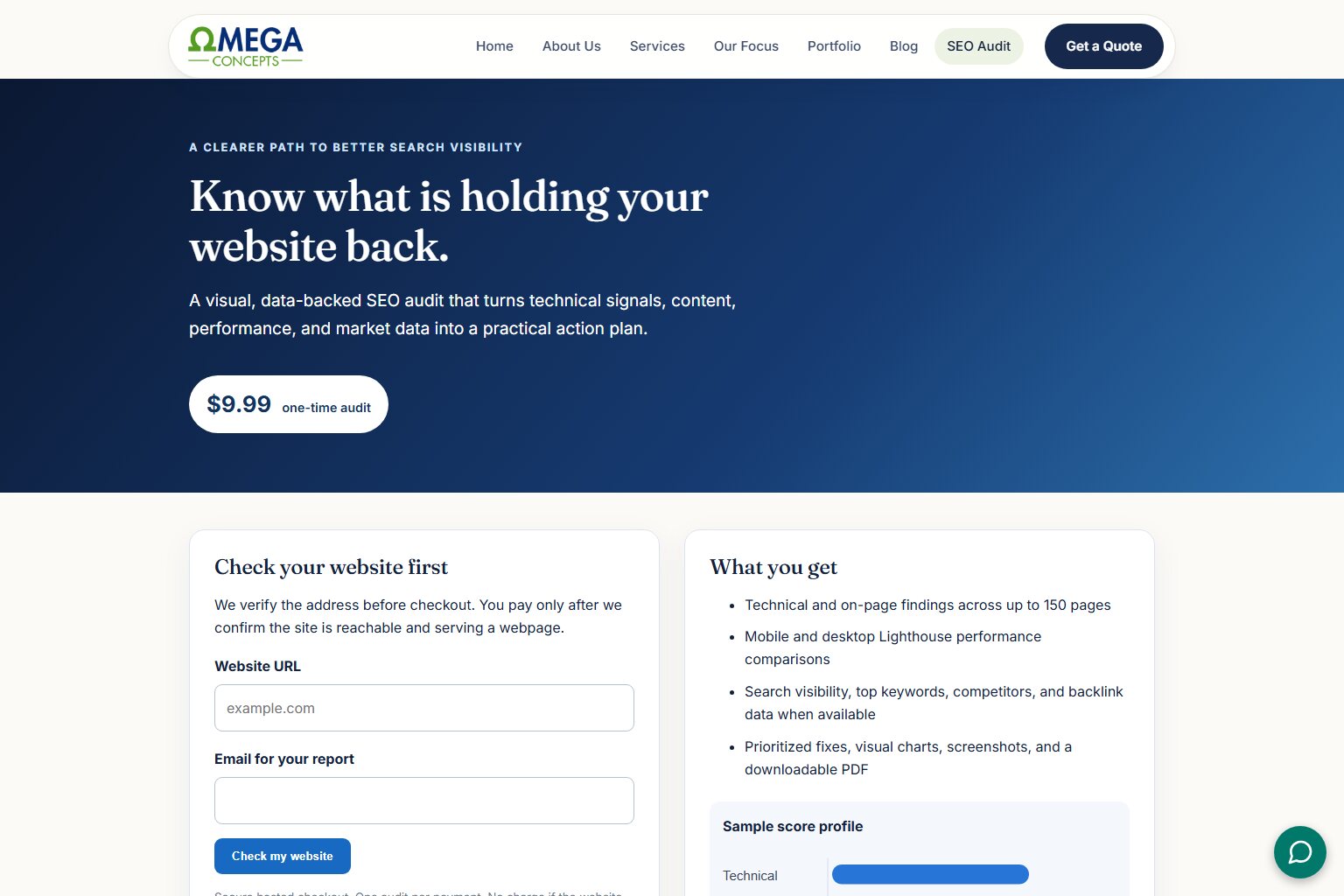
Our SEO Audit Tool is a practical way to review a website, surface meaningful issues, and turn those findings into clear next steps. We built it for website owners who want a straightforward audit without unnecessary complexity, and for agencies that need a professional report they can share with clients. The product combines technical and on-page checks, mobile and desktop performance findings, and search visibility comparisons into one polished deliverable. You can explore the SEO audit tool from Omega Concepts to see how the process is structured around a simple flow: Verify, Measure, Improve.
The problem it solves
Many website owners know they should review their site for SEO issues, but the audit process often feels fragmented. One tool may focus on performance, another on page-level recommendations, and another on search visibility. Even when the data is available, it is not always organized in a way that helps someone decide what to do first. That gap between raw findings and practical action is where this tool is meant to help.
We designed the product to reduce friction at the start of the process as well. Before payment, the URL is verified so the site is confirmed reachable first. That keeps the experience simple and avoids charging for a site that cannot be checked. From there, the audit is positioned as an accessible one-time review at $9.99, giving website owners a clear path to get a structured assessment of their site.
The result is an audit that helps people move from uncertainty to action. Instead of forcing users to assemble results from multiple sources, the tool brings key findings together in a polished PDF report with actionable priorities. That makes it easier to understand what matters, what can be improved, and what should be addressed first.
What we built
We built an SEO audit tool that reviews a website across several important dimensions and packages the output into a professional report. The audit covers technical and on-page findings across up to 150 pages, giving users a broader view than a single-page snapshot. It also includes mobile and desktop performance findings based on Lighthouse, along with search visibility comparisons to add useful context around how a site appears in search-related terms.
Just as important as the checks themselves is the final presentation. We created the output as a polished PDF report with actionable priorities so the findings are not just descriptive, but usable. Whether the reader is a business owner reviewing their own site or a team member planning improvements, the format is intended to support decision-making rather than overwhelm it.
For agencies, we also support white-label or co-branded reports on request. That allows partners to use the audit process in a client-facing workflow while still presenting the results in a format aligned with their own brand or a shared presentation model.
How it works and its key features
The product follows a simple three-step structure: Verify, Measure, Improve. That flow shapes both the user experience and the logic of the tool.
- Verify: The URL is checked first to confirm the site is reachable. You pay only after the site is confirmed reachable.
- Measure: The audit gathers technical and on-page findings across up to 150 pages, along with mobile and desktop performance findings and search visibility comparisons.
- Improve: The results are organized into a polished PDF report with actionable priorities so users can focus on the most relevant next steps.
Each of these stages addresses a practical need. Verification removes uncertainty at the start. Measurement creates a wider picture of site health by looking beyond a single page. Improvement is where the findings become useful, because the report is designed to help users identify what to work on first rather than simply listing observations.
Several features define the product:
- Accessible one-time pricing: A $9.99 one-time audit makes the tool easy to try.
- Pre-check before payment: The site must be confirmed reachable before payment is required.
- Broader page coverage: Findings span up to 150 pages, which helps surface patterns that may not be visible in a limited review.
- Performance insight on both major contexts: Mobile and desktop Lighthouse findings are included.
- Search visibility context: Comparisons add another perspective beyond page-level checks.
- Professional reporting: A polished PDF makes the audit easy to review and share.
- Agency flexibility: White-label or co-branded reports are available on request.
For users who want a concise, structured starting point, this combination is the real value of the SEO audit report service. It keeps the process understandable while still covering the areas most people expect from a practical SEO review.
The design decisions behind it
When we build tools like this, we focus on removing ambiguity. One of the clearest design decisions here is the emphasis on a simple process. Verify, Measure, Improve is not just a tagline; it is a way of making the product easier to understand from the first interaction. Users should know what happens first, what the tool evaluates, and what they receive at the end.
Another important decision was to prioritize a report that people can actually use. Audit tools often produce large volumes of information, but that does not always help with follow-through. By presenting findings in a polished PDF with actionable priorities, we aimed to make the output easier to review, easier to share internally, and easier to turn into a checklist for improvement.
We also chose to combine multiple kinds of insight in one place. Technical and on-page findings address foundational issues across the site. Mobile and desktop Lighthouse findings help frame performance from two key usage contexts. Search visibility comparisons add a broader layer of perspective. Together, these elements create a more rounded review without requiring the user to manage several disconnected tools.
The agency option reflects another practical design choice. White-label or co-branded reporting on request means the tool can work both as a direct product for site owners and as a useful reporting component for partners. That flexibility matters because the same audit can support very different workflows depending on who is using it.
Who it is for
This tool is for website owners who want to identify issues and understand where to focus next. It is especially useful for people who need a structured overview rather than a collection of disconnected metrics. Because the audit includes technical and on-page findings across up to 150 pages, it can help users look beyond isolated problems and see issues that may affect multiple parts of a site.
It is also a strong fit for teams that want a deliverable they can circulate easily. A polished PDF report with actionable priorities is easier to discuss than a raw list of checks, and that matters when decisions involve more than one person.
For agencies, the value is slightly different but equally practical. The availability of white-label or co-branded reports on request makes it possible to use the audit as part of a client service process. That can help agencies present findings in a more client-ready format while still benefiting from a structured audit workflow.
In all of these cases, the core appeal is clarity. The tool is not positioned as an abstract analytics layer. It is built to help people find issues, understand them in context, and receive a report that supports next steps.
How to try it
Trying the tool is straightforward. Start by visiting the SEO audit page and entering the website you want to review. The URL is verified first, and you only pay after the site is confirmed reachable. From there, the audit measures technical and on-page findings across up to 150 pages, includes mobile and desktop Lighthouse findings, and adds search visibility comparisons. The end result is a polished PDF report with actionable priorities that can guide your next improvements.
If you are an agency, you can also consider the reporting options available on request, including white-label or co-branded reports. That makes the product useful not only as a direct audit for your own site, but also as a reporting asset for client work.
To see more of what we build, visit our portfolio or reach out through our contact page.